


Ever found a dusty shoebox of old baseball cards in an attic and wondered what to do with them? Most people’s first thought is about value—the hunt for a rare treasure. But what if the real magic isn’t locked away in a price guide? Imagine using those cardboard legends to play a game on your kitchen table, creating your own personal all-star team for a game night. Check out Daftar JAGO189 to know more
Long before fantasy sports leagues dominated our phones, this was the original fantasy baseball. For generations, fans have used nothing more than player cards, a pair of dice, and a little imagination to stage their own World Series matchups. This is one of the most fun games to play with a deck of baseball cards, turning static images of Hall of Famers into active participants in a game you control. It’s a chance to finally answer the question, “What if Babe Ruth faced a modern-day pitcher?”
Forget the idea that you need mint-condition, valuable cards. The beauty of a vintage baseball card game is its accessibility. You don’t need to know a thing about the collecting hobby, and in fact, worn-out, common cards that you aren’t afraid to handle are perfect for playing. This guide isn’t about investing; it’s about rediscovering a simple, hands-on pastime.
This simple tradition offers a fantastic, screen-free way to connect with family and bring a piece of history to life. It’s an activity that sparks curiosity and creates memories, whether you’re introducing a new generation to the sport or just looking for something different to do. Ready to bring those players off the bench and into the game? Here’s how you can get started in just a few minutes.
Your 5-Minute Setup: The Only Four Things You Need to Play
Forget any idea that you need rare collectibles or a fancy board. You can assemble your own homemade baseball game with player cards in less than five minutes using items you likely already have. This is all about fun and imagination, not investment value, so there’s no need to buy a thing.
All you need to get started are these four simple items:
- A handful of baseball cards (about 20-30 to start)
- Two standard six-sided dice
- A piece of paper
- A pen or pencil
For the cards, dig out those common players you have lying around. This DIY baseball card board game is actually perfect for the cards that aren’t worth much money. The condition doesn’t matter at all—dings and soft corners are just part of their history. Think of them as your game pieces, not museum artifacts. The paper and pencil are simply for drawing a basic diamond and tracking your score. With your items gathered, you’re ready to learn the rules and step up to the plate.
How to Play Your First At-Bat: The Basic Dice Roll
You’ve got your cards, dice, and paper ready. The big question is: how do you get a hit from a static baseball card? The answer lies in the dice roll. Think of each player card as a unique character sheet, and the dice determine which of their special skills gets used. When a player is “at bat,” you’ll simply roll the two dice. That number, from 2 to 12, is the key that unlocks the action for that player’s turn at the plate.
Deciding what those dice rolls mean is where you get to be the game designer, creating simple baseball card game rules for beginners. Grab one of your player cards—let’s say it’s a famous slugger. On your piece of paper, write his name, and next to it, assign a few outcomes to the best dice rolls. It could be as simple as this: Roll a 12 = Home Run. Roll an 11 = Double. For a player known more for speed than power, maybe a 12 is only a single, but a 10 is a “Stolen Base.” You are now using player stats for tabletop baseball in the most fun and straightforward way possible, translating their real-life abilities into game events.
With your simple chart made, you’re ready to play. Let’s say your batter is up, and you decided that for him, a roll of 7 results in a “Single.” You roll the dice, and they land on a 7. Success! He got a hit. You’d mark a runner on first base on your hand-drawn diamond. But what if you rolled a 5? If you didn’t assign an outcome to that number, it’s an automatic out. Just mark one out for the inning, and the turn is over. That’s it—you now know how to determine a hit with baseball cards.
You’ve just completed your first at-bat! You can already play a simple version of the game this way, but a real game needs a defense trying to stop them. To make it feel more like baseball, you need a pitcher challenging that batter, creating a true duel at the plate.
It Takes Two to Play: How to Add a Pitcher to the Game
So far, your batter has been facing off against the luck of the dice. While fun, it’s a bit like a home run derby. True baseball is a duel between the batter and the pitcher. Adding a pitcher’s card is the single best way to make your game more exciting and create a proper baseball card game for two players, where one person manages the hitters and the other commands the pitchers.
The new turn structure is simple and creates fantastic moments of suspense. When the batter is up, you still roll two dice. First, you check the batter’s personal chart to see if they got a hit. But what if the number you rolled isn’t a hit for them? Instead of an automatic out, the turn isn’t over yet. Now, the focus shifts to the pitcher. This is their moment to shine—or to fail.
Just as you did for your hitters, you’ll create a simple chart for your pitcher. A dominant pitcher like Bob Gibson might have “Strikeout” assigned to several dice roll numbers. A less intimidating pitcher might have more “Walk” or “Single” results on their chart. This is the key difference in a baseball card game vs dice baseball played solo; it’s no longer just about the batter’s skill, but a tug-of-war between two opposing players represented by their cards.
This back-and-forth is where the magic happens. The batter rolls an 8, hoping for a double, but their chart is blank. Everyone holds their breath as you then check the pitcher’s card for the number 8. Is it a strikeout? A weak groundout? Or did the pitcher mess up and give up a walk? You’ve now created the game’s core conflict. With hits and outs decided by this duel, all that’s left is to score the game and see who wins.
From Hits to Runs: How to Keep Score and Win the Game
You’ve created hits and outs, but where do the players go? This is where your tabletop game truly comes to life. Grab a piece of paper and sketch a simple baseball diamond—it’s the perfect foundation for a DIY baseball card board game. On that same paper, create a space to track outs. Each time a player makes three outs, their turn at bat, known as an “inning,” is over. Then, it’s the other player’s chance to hit. You can use coins or little scraps of paper to represent your runners on base.
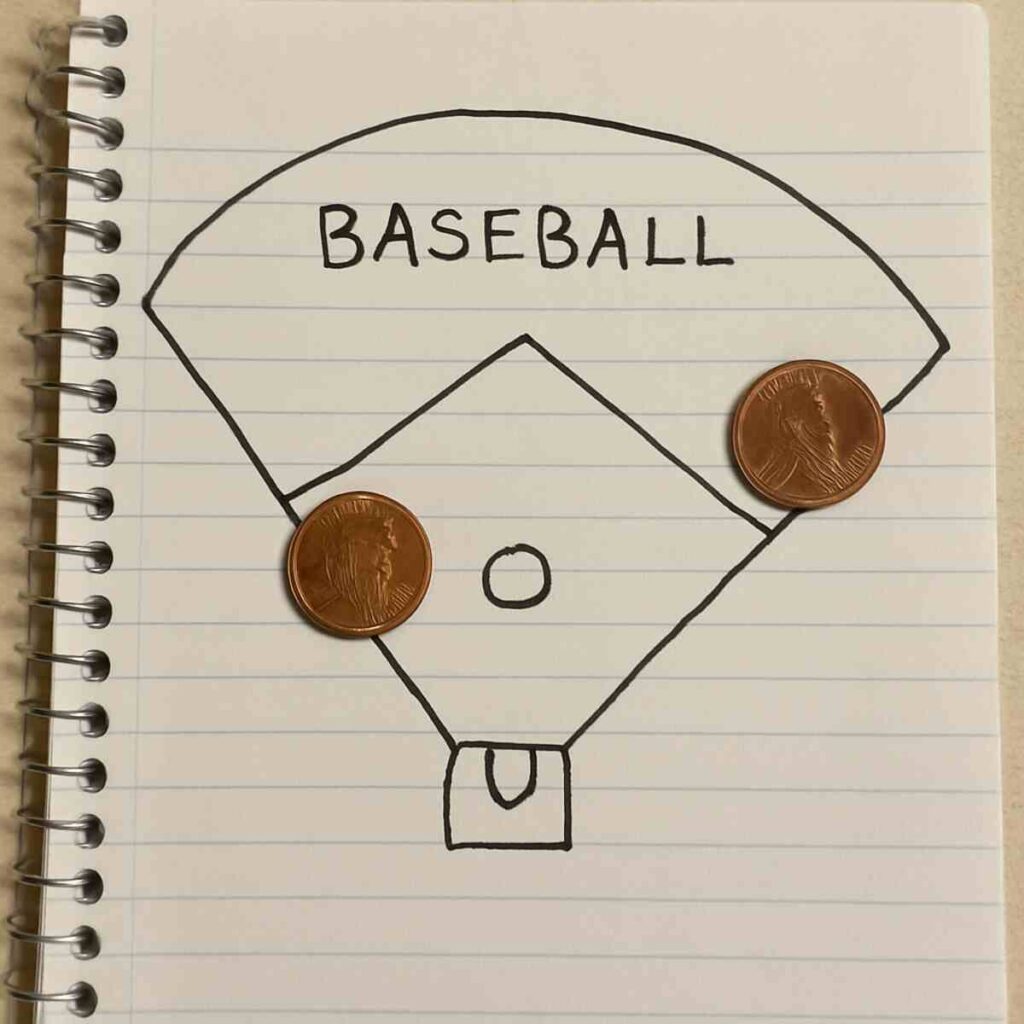
Moving runners around the bases is how you score points. Don’t worry about complex strategies; for these baseball card game rules for beginners, we keep it simple. When your batter gets a hit from the dice roll, just follow these basic steps to advance your runners:
- Single: The batter moves to first base. All other runners advance one base.
- Double: The batter moves to second base. All other runners advance two bases.
- Home Run: The batter and all runners on base score a run!
Every time a runner makes it all the way around the diamond and crosses home plate, put a tally mark on your scoreboard—that’s one run. So, how do you know who wins? A standard game lasts for nine full innings. After both players have had their nine turns at bat, the person with the most runs is the victor. If you’re short on time, a three or five-inning game is just as fun. Now that you understand scoring, the next fun challenge is deciding who should be on your team.
Building Your Team: Which Cards Make the Game More Fun?
So, which players should you draft for your tabletop team? The first instinct might be to protect rare or valuable cards, and that’s a good one. For this game, you don’t need Hall of Famers in mint condition. In fact, the best baseball cards for playing a game often come from what collectors call the “Junk Wax Era.” This term refers to cards made in massive quantities from the mid-1980s to the early-1990s. They’re incredibly affordable and easy to find, making them perfect, worry-free game pieces.
Once you have a stack of players, you can add a fascinating new layer to your game: tabletop baseball using real player stats. Flip a card over and look at the grid of numbers on the back. You don’t need to be a math whiz to use them. For example, if you have a slugger like Jose Canseco who hit 40+ Home Runs (HR), you can make a house rule: if you roll a 12 with him at bat, it’s an automatic Home Run! If you’re using a speedy player like Rickey Henderson, maybe a roll of 2 is a Stolen Base. This is how you can play a game with Topps baseball cards and make each player feel unique.
This simple customization is where the real magic happens. Your game becomes a time machine, allowing you to create matchups that never happened in real life. What if a fireball-throwing pitcher from 1992 had to face a legendary contact hitter from 1978? Because you aren’t bound by historical accuracy, you can build your ultimate fantasy team, mixing and matching stars from different decades. The goal isn’t to create a perfect simulation, but to ask “what if?” and find out with a roll of the dice.
Creating your team with stats and “what-if” scenarios adds a wonderful strategic element to the game. However, if you’re looking for a faster contest that relies more on schoolyard chance than on player statistics, there’s another classic way to put your cards into action.
Need a Faster Game? Try the Classic Baseball Card Flipping Game
If using player stats and dice feels like a bit too much setup, there’s an even simpler, faster-paced game you can play. This one has been a schoolyard staple for generations and relies on skill and a little bit of luck instead of strategy. Known as “tops” or simply card flipping, it’s one of the most fun games to play with a deck of baseball cards because you don’t need a table, dice, or even a pencil. All you need is a friend, a few cards you don’t mind getting a little scuffed, and a bit of open floor space.
The goal is to win your opponent’s cards in a winner-take-all contest. The simple baseball card flipping game rules are easy enough for anyone to learn in seconds:
- Step 1: The first player gently tosses a card onto the ground, face up. This is the target.
- Step 2: The second player stands in the same spot and tries to flip their card so that it lands on and covers any part of the first player’s card.
- Step 3: If they succeed, they win both cards!
- Step 4: If they miss, their card stays on the ground, becoming another potential target for the next player.
What makes this game so enduring is that it’s a contest of pure dexterity. It’s less about who is on the card and more about how you flick your wrist. Can you get the card to sail and float, or will it dive straight to the ground? This physical challenge is a refreshing change of pace and a perfect way to figure out what to do with old baseball cards that aren’t valuable collectibles. It’s a wonderfully portable and nostalgic activity that connects you to a long-lost tradition of playground fun.
Ready for the Big Leagues? Where to Go for More Advanced Games
While creating your own baseball card game is a fantastic way to spend an afternoon, you might eventually crave more depth and realism. What if you wanted your tabletop game to reflect how players actually performed in a specific season? This is the next step in the hobby, moving from a simple homemade game to a detailed simulation. It’s the difference between a fun game of backyard baseball and a full nine-inning contest in a stadium.
Fortunately, a few companies have dedicated decades to perfecting tabletop baseball using real player stats. Two of the most legendary names in this world are Strat-O-Matic and APBA. Instead of you having to invent the rules, these companies sell complete games with professionally designed player cards and comprehensive rulebooks. Each card is engineered based on a player’s real-life performance, creating a highly accurate baseball card game that feels much more strategic than simple dice baseball.
The real magic of these games lies in their statistical accuracy. They answer the ultimate “what-if” questions for sports fans: Could Babe Ruth’s 1927 Yankees beat a modern-day champion? How would a legendary pitcher from the 1960s fare against today’s top hitters? By turning complex data into playable outcomes, these games allow you to manage your dream team and watch history unfold on your kitchen table, one dice roll at a time.
Your Turn at Bat: Start Your Own Tabletop Baseball Tradition
That shoebox of old baseball cards is no longer just a collection of dusty relics. Where you once saw static images and forgotten names, you now see an all-star roster waiting for a manager. You’ve unlocked the secret to transforming those cardboard legends into active players, equipping yourself with everything needed to run your own vintage baseball card game right on the kitchen table.
Your first step is simple: grab any handful of cards, a pair of dice, and a piece of paper. Don’t worry about player stats, card condition, or rarity. This is one of the most fun games to play with a deck of baseball cards precisely because the only goal is connection and imagination. Remember, success isn’t finding a rare treasure; it’s the thrill of a close game that comes down to the final roll.
You now hold the power to bring history to life, creating dream matchups and sharing stories in a way that feels immediate and real. This is the answer to the question of what to do with old baseball cards—you play with them. So go ahead, manage your team, and let the dice fly. Your first game is just one roll away.
